
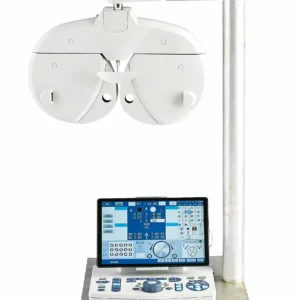
Phoropters: Manual & Auto Refraction Equipment

Phoropters — Manual & Auto Refraction Instruments Guide

A phoropter (also called a refractor or phoroptometer) is an ophthalmic instrument that holds trial lenses in front of a patient’s eyes to determine their exact eyeglass prescription through subjective refraction — a process where the patient compares lens pairs and reports which looks clearer. Supplied by BrightVision Tech, a specialized ophthalmic equipment supplier, we offer two types: a motorized auto phoropter for high-volume clinics and a classic manual phoropter for practices that prefer a proven, electricity-free workflow.

What Is a Phoropter?

A phoropter (also called a refractor) is an ophthalmic instrument used to determine a patient’s exact eyeglass prescription through subjective refraction. Unlike an auto refractometer that produces objective readings in seconds, a phoropter relies on patient feedback, making it the gold standard for final prescription determination.

The instrument’s rotating dial banks hold dozens of spherical and cylindrical lenses, plus prism lenses, Jackson cross cylinders, and a Risley rotary prism. The examiner rotates the dials while the patient reads a vision chart, refining sphere, cylinder, and axis values to within ±0.25 D precision.

Reference: The American Academy of Ophthalmology (AAO) lists subjective refraction with a phoropter as the final step in comprehensive eye examination workflows.

How Does a Phoropter Work?

During refraction, the examiner follows a standard sequence:

1. Position the patient — seated comfortably with the phoropter swung in front of their face, forehead against the rest and chin on the chinrest.
2. Set the pupil distance (PD) to match the patient’s interpupillary distance.
3. Establish baseline — occlude one eye and present the patient with a distance vision chart.
4. Determine sphere — use the cross-cylinder to find the spherical power that gives the sharpest image.
5. Determine cylinder and axis — for astigmatic patients, refine the cylindrical correction and its axis orientation.
6. Test binocular balance — verify both eyes are balanced for comfortable distance vision.
7. Measure near refraction — flip the phoropter to the near-point rod position and repeat for reading correction.

A complete phoropter refraction takes 10–15 minutes per patient. The final prescription is the result the patient confirms as clearest — a more accurate endpoint than objective measurement alone.

AP100 vs MP300: Which BVT Phoropter Do You Need?

Auto Phoropter (AP100) — Motorized lens switching for faster exam workflow. Requires AC power. Supports wireless chart projector integration. Best for high-volume clinics and optical chains.
Manual Phoropter (MP300) — Classic dial rotation, fully mechanical with no power required. Standalone use. Best for independent practices, distributors, and low-budget setups.

What Can Phoropters Measure?

A phoropter measures and refines the following optical values:

Sphere (SPH) — degree of nearsightedness (myopia) or farsightedness (hyperopia), from -20.00 D to +20.00 D
Cylinder (CYL) — amount of astigmatism correction, typically ±6.00 D
Axis — orientation of astigmatism correction (1° to 180°)
Prism — correction for eye alignment issues (strabismus, heterophoria), up to 20Δ
Add (ADD) — near addition power for presbyopia (typically +0.75 D to +3.50 D)
Pupil distance (PD) — adjustable to match patient anatomy

Both BVT models cover the full clinical range. The MP300 (manual) adds cross-cylinder refinement knobs for the most precise axis determination. The AP100 (motorized) automates lens switching for faster exam flow.

Who Uses Phoropters?

Eye clinics — subjective refraction for comprehensive eye exams
Optometry practices — routine prescription determination
Optical retail chains — standardized refraction across multiple locations
Equipment distributors — essential instrument for any ophthalmic product portfolio
Ophthalmology departments — final prescription confirmation after auto refraction

Phoropter vs Auto Refractor

Modern eye exams use both instruments in sequence:

Measurement type: Auto refractor is objective (no patient feedback); phoropter is subjective (patient compares)
Time per patient: Auto refractor 60 seconds; phoropter 10–15 minutes
Output: Auto refractor gives a starting-point prescription; phoropter gives the final confirmed prescription
Operator skill: Auto refractor is technician-level; phoropter requires optometrist or ophthalmologist

Typical workflow: Auto refractor first (objective reading as a starting point), then phoropter (refined subjective prescription). For straightforward cases, the two values often match closely. For complex prescriptions (high astigmatism, irregular corneas, pediatric patients), the phoropter is essential — the auto refractor cannot reliably capture subjective preference.

Key Features to Look For in a Phoropter

When evaluating a phoropter for your practice, prioritize these specifications:

Measurement range — Sphere ±20D, Cylinder ±6D, Add +0.75 to +3.50D covers virtually all clinical cases
Dial operation — Smooth mechanical resistance; auto phoropters should also have manual override
Cross-cylinder — ±0.25D or ±0.50D, with tactile click stops for axis refinement
Risley rotary prism — built-in or add-on; essential for vergence testing
Pupil distance range — 55–75 mm typical, accommodates pediatric to adult
Near vision rod — included standard for presbyopia testing
Power source — Manual (no power needed) vs Motorized (AC or rechargeable battery)

The BVT MP300 (manual) is fully mechanical — zero downtime from power issues. The BVT AP100 (motorized) adds wireless chart projector integration and motorized lens switching for high-volume clinics.

How to Use a Phoropter (Step by Step)

A complete subjective refraction follows this sequence:

1. Position the patient in the chair, swing the phoropter to their face, set the PD.
2. Occlude the non-tested eye and present the 20/40 line on the distance chart.
3. Sphere fogging — add +1.00 D to relax accommodation, then reduce plus power until the patient reads the 20/20 line.
4. Jackson cross-cylinder — refine cylinder axis first (rotate ±5°), then cylinder power (±0.25 D steps).
5. Repeat for the other eye.
6. Binocular balance — verify both eyes see equally clear with the final prescription.
7. Near refraction — flip the phoropter to near position, repeat for presbyopia correction.
8. Record the final prescription — sphere, cylinder, axis, add, and prism (if any).

The MP300 requires manual dial rotation; the AP100 motorizes steps 3–4 for faster workflow and integrates with a wireless chart projector for presentation.

Maintenance and Care

Phoropters require minimal maintenance but benefit from routine practices:

Daily: Wipe the chinrest and forehead rest with alcohol-free disinfectant wipes between patients
Weekly: Inspect lens banks for fingerprints or dust; clean with lens tissue only
Monthly: Verify dial alignment with the calibration reference card
Annually: Factory recalibration to maintain accuracy within ISO 10341 tolerances
For AP100 (motorized): Check battery health monthly, perform full discharge–recharge cycle quarterly

With proper care, a BVT phoropter delivers 12–15+ years of service — among the longest lifespans in any ophthalmic instrument category.

OEM & Custom Branding

Both phoropter models support OEM customization — add your logo, brand colors, and custom packaging. Learn about our OEM options →

Frequently Asked Questions

Which phoropter should I choose?
If your clinic handles a high volume of patients, the Auto Phoropter (AP100) will speed up your workflow with motorized lens switching and wireless chart integration. For smaller practices or distributors seeking a proven, budget-friendly option, the Manual Phoropter (MP300) is an excellent choice.

What is the difference between a phoropter and an auto refractor?
An auto refractor provides objective measurements in under 60 seconds — a starting-point prescription. A phoropter performs subjective refraction with patient feedback, giving the final confirmed prescription. Most practices use both in sequence.

Do phoropters require power?
The MP300 (manual) is fully mechanical and needs no power. The AP100 (auto) requires AC power for motorized lens switching.

Do phoropters require calibration?
Both models are factory-calibrated. Periodic checking is recommended for consistent accuracy, with annual factory recalibration to maintain ISO 10341 tolerances.

Can I get a custom-branded phoropter?
Yes. We offer OEM customization on both models, including your logo, brand colors, and packaging. Contact us for details →

Does the phoropter include a near vision rod?
Yes. Both models come with a near vision rod for near-point testing, allowing examiners to conduct distance and near refraction in a single setup.

What is the typical lifespan of a phoropter?
With proper maintenance, a BVT phoropter delivers 12–15+ years of service — among the longest lifespans in any ophthalmic instrument category.

Get a Quote for Phoropters →

  • Auto phoropter by BrightVision Tech

    Auto phoropter

    Features:

    • Flexible operation, convenient, high accuracy, stable performance, strong and durable.
    • Choose high quality optical lens, high quality motor, reasonable design of electronic control system
    • The parts are manufactured with imported high-precision CNC equipment, which greatly improves the precision of the parts and the quality is more stable.
    • Using Bluetooth connection technology, connecting the chart projector and other equipment, with a new data transmission mode to make optometry more efficient.
    • The software interface layout is more consistent with the intuitive identification and reading.
    • The control key table layout is more in line with the operation habits of the optometrists.
    Select optionsLoading Done This product has multiple variants. The options may be chosen on the product page
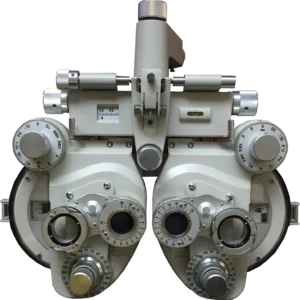
  • Manual Phoropter VIM-300

    Manual Phoropter VIM-300

    Features:

    • Beautiful design with good hand feeling.
    • Able to check ALL-SIDE visual function, accurate and comfortable measurement; High-grade plated film used in all optical lens;
    • Concentrated operation and large scale and improving performance.
    • Automatically connect between cross-cylinder lens and lens coordinates.
    • White and Black colors for your options.