Auto Lensmeter D907
A tabletop lensmeter for retail opticians and clinic dispensaries needing reliable lens verification during daily production. Its measurement flow supports consistent results across mixed lens types and frame jobs.

Auto Lensmeters — Complete Digital Lens Measurement Guide
An auto lensmeter (also called a digital lensmeter or automated lensmeter) is an electronic instrument that measures the optical power of eyeglass lenses, contact lenses, and other ophthalmic lenses. Supplied by BrightVision Tech, a specialized ophthalmic equipment supplier, our D907 and D908 models deliver fast, objective measurements for optical labs, eye clinics, and retail stores worldwide.
What Is an Auto Lensmeter?
An auto lensmeter is an electronic instrument that measures the optical power of eyeglass lenses, contact lenses, and other ophthalmic lenses. Unlike traditional manual lensmeters that require the operator to interpret a target image through an eyepiece, an auto lensmeter displays objective measurement results — sphere, cylinder, axis, prism, and add power — instantly on a digital screen.
Auto lensmeters are the standard equipment in modern optical labs, eye clinics, and retail optical stores. They form the quality-control backbone of any practice that verifies lens power before dispensing eyewear to a patient.
How Does an Auto Lensmeter Work?
The instrument projects a pattern of light through the lens being measured. A built-in sensor array analyzes how the lens refracts the pattern, and the device calculates the lens power mathematically. Results appear on the LCD screen within 2–3 seconds, with no operator interpretation required. A built-in thermal printer produces a permanent paper record for each measurement.
D907 vs D908: Which BVT Lensmeter Do You Need?
D907 — 5.6″ color LCD. Compact, cost-effective standard model. Measures all lens types (single vision, bifocal, progressive). Built-in thermal printer. Best for standard optical labs and clinics.
D908 — 8.0″ color LCD. Larger screen for enhanced visibility and easier data reading. Same measurement capabilities as D907. Built-in thermal printer. Best for users who prefer larger display output in busy lab environments.
What Lens Types Can Auto Lensmeters Measure?
BVT auto lensmeters support measurement of all common ophthalmic lens types:
Single vision lenses — distance or reading corrections
Bifocal lenses — distance + near segments
Progressive lenses — seamless multi-distance correction
Prism lenses — prescribed prism for eye alignment
Contact lenses — soft and rigid gas-permeable
Who Uses Auto Lensmeters?
Optical labs — verify lens power before and after edging/mounting
Eye clinics — confirm incoming lenses match prescriptions
Optical retail stores — quality check on dispensed eyewear
Lens manufacturers — quality control during production
Equipment distributors — essential tool for any optical equipment portfolio
Auto Lensmeter vs Manual Lensmeter — Which Should You Choose?
Manual lensmeters require the operator to look through an eyepiece and visually align a target — a skill that takes training and produces variability between operators. Auto lensmeters remove operator interpretation entirely: place the lens, press a button, read the result.
For high-volume practices (50+ lenses per day), an auto lensmeter saves 1–2 minutes per measurement — translating to hours per week. For modern practices, auto lensmeters are the standard choice; manual lensmeters remain useful only as backup devices or for specialty applications.
Key Features to Look For in an Auto Lensmeter
Display size: 5.6″ LCD is standard; 8.0″ or larger improves readability in busy labs
Lens type support: must handle single vision, bifocal, progressive, and contact lenses
Built-in thermal printer: eliminates manual data entry into EHR systems
Auto-orientation: detects lens rotation automatically, reducing operator error
Measurement speed: under 3 seconds per lens keeps high-volume workflows efficient
UV/Blue light measurement: increasingly requested as blue-light coatings become standard
Both BVT models cover all of the above. The choice between D907 and D908 comes down to display size preference and lab ergonomics.
How to Use an Auto Lensmeter (Step by Step)
Using an auto lensmeter takes less than a minute per lens. Follow these standard steps:
Power on the device and allow it to complete its self-calibration cycle
Clean the lens with a lint-free cloth to remove dust or fingerprints
Position the lens on the lens rest, convex side up, centered on the marking dot
Lower the lens holder gently until it secures the lens in place
Align the optical center using the on-screen crosshair guide
Press the measure button — results display within 2–3 seconds
Print the result using the built-in thermal printer for record-keeping
For progressive lenses, the lensmeter guides you through distance, intermediate, and near reference points in sequence.
Maintenance and Care
Auto lensmeters require minimal maintenance but benefit from these routine practices:
Daily: Wipe the lens rest and stage with a microfiber cloth to remove lens residue
Weekly: Verify calibration using the reference lens included with the device
Monthly: Inspect the thermal printer paper supply and replace as needed
Annually: Schedule factory calibration to maintain ANSI Z80.1 lens power tolerance compliance
With proper care, a BVT auto lensmeter delivers 8–10+ years of reliable service in a typical clinical setting.
OEM & Custom Branding
Both D907 and D908 support OEM customization — your logo, brand colors, and packaging. Learn about OEM options →
Frequently Asked Questions
What is the difference between an auto lensmeter and a manual lensmeter?
An auto lensmeter displays objective digital readings on a screen; a manual lensmeter requires the operator to interpret a target image through an eyepiece. Auto lensmeters are faster, more consistent, and require less operator skill.
Can auto lensmeters measure progressive lenses?
Yes. Both the D907 and D908 measure all lens types including single vision, bifocal, and progressive lenses. The device guides the operator through distance, intermediate, and near reference points.
What is the difference between D907 and D908?
The main difference is the display size. The D907 has a 5.6″ screen and the D908 has an 8.0″ screen. Both offer the same measurement capabilities.
Do I need an auto lensmeter or a manual one?
For any modern optical lab or clinic, an auto lensmeter is the standard choice. Manual lensmeters are typically used only as backup devices or for specialty applications.
How accurate are BVT auto lensmeters?
BVT auto lensmeters are calibrated to ANSI Z80.1 tolerances for ophthalmic lens power measurement, the industry standard for prescription eyewear.
How long does a measurement take?
Each lens measurement completes in 2–3 seconds, with results displayed instantly on the LCD screen and printable via the built-in thermal printer.
Do you offer warranty and support?
Yes. Contact our team for warranty details specific to your region and order volume. Get in touch →
Showing all 2 results
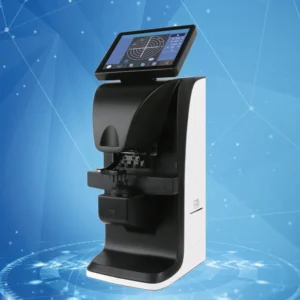
A tabletop lensmeter for retail opticians and clinic dispensaries needing reliable lens verification during daily production. Its measurement flow supports consistent results across mixed lens types and frame jobs.
A verification lensmeter for optical labs and dispensaries checking mixed lens inventories — single vision, bifocal, and progressive. Its fast measurement cycle supports quality control across back-to-back dispensing jobs.