Auto Refractometer 8900
A dual-function refraction workstation for comprehensive practices and optical retail needing objective readings at scale. Its capture flow supports efficient throughput across high daily patient volume.

Auto Refractometers — Objective Refraction & Keratometry Measurement Guide
An auto refractometer (also called an autorefractor) is an electronic ophthalmic instrument that objectively measures the refractive error of the human eye — sphere, cylinder, and axis — without requiring patient feedback. Supplied by BrightVision Tech, a specialized ophthalmic equipment supplier, our three models (8900, 900, and 710) cover every practice size, workflow, and budget — from compact single-room clinics to high-volume optical chains.
What Is an Auto Refractometer?
An auto refractometer is an electronic ophthalmic instrument that objectively measures the refractive error of the eye — sphere, cylinder, and axis — without requiring patient feedback. The result is a clinical starting point for subjective refraction, often cutting chair time by 30–50% versus manual retinoscopy.
Modern auto refractometers add keratometry (corneal curvature measurement) for contact lens fitting and corneal assessment. Combining refraction and keratometry in a single device saves floor space and capital budget — a key reason BVT’s 8900 and 710 models are popular with multi-location optical chains.
Reference: The American Academy of Ophthalmology (AAO) lists autorefractors as standard equipment in comprehensive eye examination workflows.
How Does an Auto Refractometer Work?
The instrument projects an infrared light pattern onto the patient’s retina and analyzes the reflected image to compute refractive error. The patient simply fixates on a target (usually a hot-air balloon or farmhouse image) while the device measures both eyes in seconds. Results display instantly on the LCD screen and print to the built-in thermal printer.
Keratometry-capable models (8900, 710) add a second optical path that measures the reflection from the corneal tear film to compute corneal curvature (K1, K2, and axis). This dual-function capability eliminates the need for a separate keratometer — a major space and cost advantage.
8900 vs 900 vs 710: Which BVT Auto Refractometer Do You Need?
8900 — Refraction + Keratometry — 5.7″ TFT LCD display. Dual function in one device. Standard footprint. Sphere ±25D, Cylinder ±10D measurement range. Best for clinics needing both refraction and keratometry without a separate device.
900 — Refraction Only — 6.5″ Touch LCD with electric adjustable jaw and auto tracking. Standard footprint. Touchscreen interface speeds up operator workflow. Best for practices prioritizing patient comfort and pediatric exams.
710 — Refraction + Keratometry — 9″ Touch LCD display. Compact size with large screen. Smallest footprint of the three. Best for space-limited practices and teaching clinics that benefit from the large display.
What Can Auto Refractometers Measure?
Sphere (SPH) — myopia or hyperopia magnitude, range ±25D
Cylinder (CYL) — astigmatism magnitude, range ±10D
Axis — astigmatism orientation, 0–180°
Keratometry (K1/K2) — corneal curvature radii, range 5.0–10.0 mm (8900, 710 only)
Corneal axis — orientation of steepest corneal meridian (8900, 710 only)
Pupil distance (PD) — measured simultaneously on most autorefractor models
Who Uses Auto Refractometers?
Eye clinics — objective refraction as a starting point for comprehensive exams
Optical retail chains — fast pre-screening across multiple locations
Hospital eye departments — repeatable measurements for high patient volume
Contact lens fitters — keratometry values guide base curve selection
Equipment distributors — autorefractors are a staple in any ophthalmic equipment portfolio
Auto Refractometer vs Manual Retinoscopy
Manual retinoscopy — using a retinoscope and trial lenses — remains the gold standard for difficult cases (irregular corneas, media opacity, non-verbal patients). However, for routine comprehensive exams:
– Speed: Auto refractometer takes 60 seconds; retinoscopy 3–5 minutes per patient
– Operator dependency: Autorefractor results are reproducible across technicians; retinoscopy requires expert skill
– Pre-screening: Autorefractor values give the optometrist a reliable starting point, often saving 5+ minutes of subjective refraction time
Most modern practices use both — autorefractor for routine exams, retinoscopy for complex cases that the autorefractor flags as low-confidence.
Key Features to Look For in an Auto Refractometer
When evaluating an auto refractometer for your practice, prioritize these specifications:
– Measurement range — Sphere ±25D, Cylinder ±10D covers virtually all clinical cases
– Display — Touch LCD (900/710) is faster for operators than TFT (8900); 9″ screen (710) is ideal for teaching
– Auto tracking & auto fire — reduces operator dependency and inter-test variability
– Electric adjustable jaw — accommodates pediatric and disabled patients without repositioning
– Keratometry capability — only the 8900 and 710; the 900 is refraction-only
– Connectivity — USB + RJ45 for EHR integration; thermal printer for paper records
– Pupil zone — minimum pupil diameter 2.0 mm for reliable measurement under typical room lighting
All three BVT models cover the core clinical range; the choice depends on workflow priorities (patient comfort vs dual-function vs compact footprint).
How to Use an Auto Refractometer (Step by Step)
Power on the device and let it complete self-calibration (10–15 seconds)
Position the patient — chin on chinrest, forehead against the rest band
Instruct the patient to focus on the fixation target (usually a hot-air balloon or farmhouse image)
Align the instrument using the on-screen crosshair or joystick (auto-tracking models like the 900 do this for you)
Trigger measurement — the device captures sphere, cylinder, and axis in 2–3 seconds
Repeat 3 times per eye; the device averages results for reliability
Print or export the result to your EHR via the built-in printer or USB/RJ45 interface
On keratometry-capable models (8900, 710), corneal curvature values appear alongside refraction data in the same printout.
Maintenance and Care
Daily: Wipe the chinrest and forehead rest with alcohol-free disinfectant wipes between patients
Weekly: Clean the objective lens with lens tissue (never use cloth or paper towels)
Monthly: Inspect the thermal printer paper supply and run a calibration test against the included reference eye
Annually: Factory recalibration to maintain measurement accuracy within ISO 10341 tolerances
With proper care, a BVT auto refractometer delivers 8–10+ years of service in a typical clinical setting.
OEM & Custom Branding
All three models support OEM customization — your logo, brand colors, and packaging. Learn about OEM options →
Frequently Asked Questions
Which auto refractometer should I choose?
If you need both refraction and keratometry, the 8900 or 710 are your best options. If patient comfort and ease of use are your priority, the 900 with its electric jaw is ideal. For tight spaces, the compact 710 is the best fit.
What is the difference between refraction and keratometry?
Refraction measures the eye’s refractive error (sphere, cylinder, axis) for prescription glasses. Keratometry measures the curvature of the cornea, which is essential for contact lens fitting and corneal assessment.
How accurate are auto refractometers?
Modern autorefractors are accurate within ±0.25D for sphere and cylinder in cooperative adult patients. Results may vary for pediatric, elderly, or patients with media opacity — manual retinoscopy is recommended for these cases.
Can auto refractometers measure children’s eyes?
Yes, but with caution. Children under 5 may have difficulty fixating reliably. The 900 with its electric jaw and auto tracking is most pediatric-friendly. For infants and non-verbal children, plus retinoscopy under cycloplegia remains the clinical standard.
How often should I calibrate the auto refractometer?
Daily self-calibration is automatic at power-on. Factory recalibration is recommended annually to maintain ISO 10341 measurement tolerances and ensure long-term accuracy.
Do the BVT models support EHR integration?
Yes. All three models have USB and RJ45 connectivity. Patient data can be exported to most practice management and EHR systems via standard protocols.
Do you offer warranty and support?
Yes. Contact our team for warranty details specific to your region and order volume. Get in touch →
Showing all 3 results
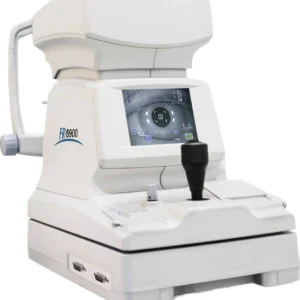
A dual-function refraction workstation for comprehensive practices and optical retail needing objective readings at scale. Its capture flow supports efficient throughput across high daily patient volume.
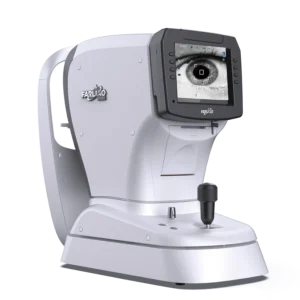
A precision auto-refractor for specialty clinics handling dense cataract and IOL workup cases. Its powered alignment supports repeatable pre-operative data capture where manual positioning is difficult.
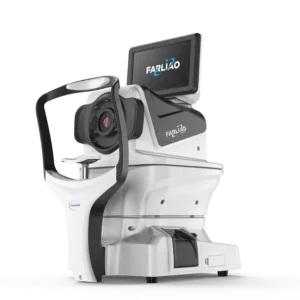
A tabletop auto-refractor for space-limited exam rooms and busy screening workflows. Its quick capture supports reliable objective readings across diverse patient populations before subjective refraction.