
Phoropter Machine: Complete Guide to Eye Exam Refraction Equipment
The phoropter machine is one of the most recognizable instruments in any eye care practice — the chrome-armed device patients sit behind while answering the optometrist’s signature question: “Which is better, one or two?” Also called a refractor, a phoropter is the clinical instrument that turns objective measurements from an auto refractor into a finalized, patient-verified eyeglass prescription.
Whether you are equipping a new optometry lane, replacing an aging unit, or upgrading from manual to digital, this guide explains how phoropters work, what to look for in a modern instrument, and how to match features and budget to your practice’s daily workflow.
- 1. What Is a Phoropter Machine?
- 2. How a Phoropter Works: The Subjective Refraction Process
- 3. Manual Phoropters vs Digital Phoropters: Which Fits Your Practice?
- 4. Key Components and What They Do
- 5. Phoropter Price Ranges at a Glance
- 6. How to Choose the Right Phoropter for Your Practice
- 7. Frequently Asked Questions
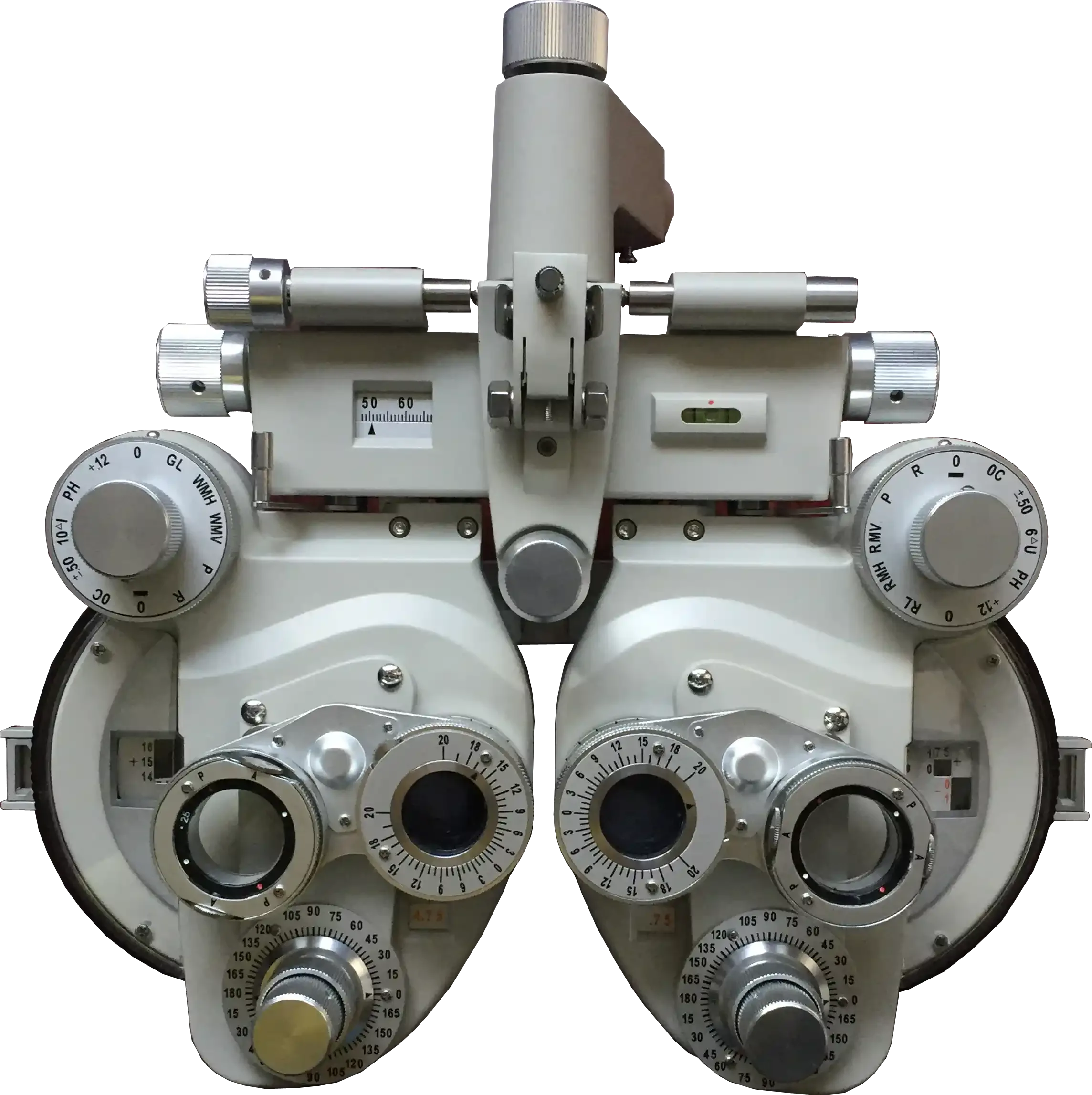
1. What Is a Phoropter Machine?
A phoropter (or refractor) is a clinical instrument that holds banks of trial lenses and lets the clinician rapidly flip between spherical powers, cylindrical powers, and axes while the patient compares clarity. The patient’s subjective preferences are translated through a series of standardized techniques — Jackson cross-cylinder, binocular cross-cylinder, prism dissociation — into a final prescription for corrective lenses.
Phoropters are used in nearly every comprehensive eye examination, typically after auto refraction and before binocular vision testing. They are also the primary instrument for over-refraction with existing eyewear and for contact lens fitting workflows.
The instrument sits on a phoropter arm mounted to the exam chair or a standalone instrument stand, positioning the lens banks at the patient’s visual axis at a fixed 12-13 mm vertex distance — the same distance used for the final eyeglass lenses.
2. How a Phoropter Works: The Subjective Refraction Process
Subjective refraction with a phoropter follows a well-defined clinical sequence. Understanding the workflow clarifies why a phoropter has so many dials, drums, and knobs.
The standard process has four stages:
| Stage | What the Clinician Does | Lens Bank Used |
|---|---|---|
| 1. Monocular Sphere | Establish initial spherical power via fogging and the “one or two” comparisons | Spherical drum (±0.25 D steps) |
| 2. Cylinder & Axis | Refine astigmatic correction with the Jackson cross-cylinder | Cylinder drum + cross-cylinder lens |
| 3. Binocular Balance | Equalize accommodation between right and left eyes | Prism or fogging lenses |
| 4. Verification | Trial-frame the final Rx and verify with the patient | Auxiliary lens bank + trial frame |
A complete subjective refraction takes 5-10 minutes on a manual phoropter and 3-5 minutes on a digital phoropter with auto sequencing — a significant productivity difference for high-volume clinics.
3. Manual Phoropters vs Digital Phoropters: Which Fits Your Practice?
The choice between manual and digital is the single most consequential buying decision. It affects upfront cost, daily workflow, staff training, and long-term upgrade path.
- Manual phoropters (e.g., VIM-300, Reichert Phoroptor, Topcon VT-10) rely on mechanical drums and dials. They are simpler, more durable, easier to service, and cost a fraction of digital units. The trade-off is operator fatigue in high-volume clinics and no electronic data capture.
- Digital phoropters (e.g., CV-700, Nidek RT-5100, Topcon CV-5000) replace mechanical dials with a control panel or touchscreen. Lens changes are motorized, prescriptions can be printed or transmitted via RS-232 / HL7 to EHR systems, and many units support auto-sequencing of cross-cylinder testing.
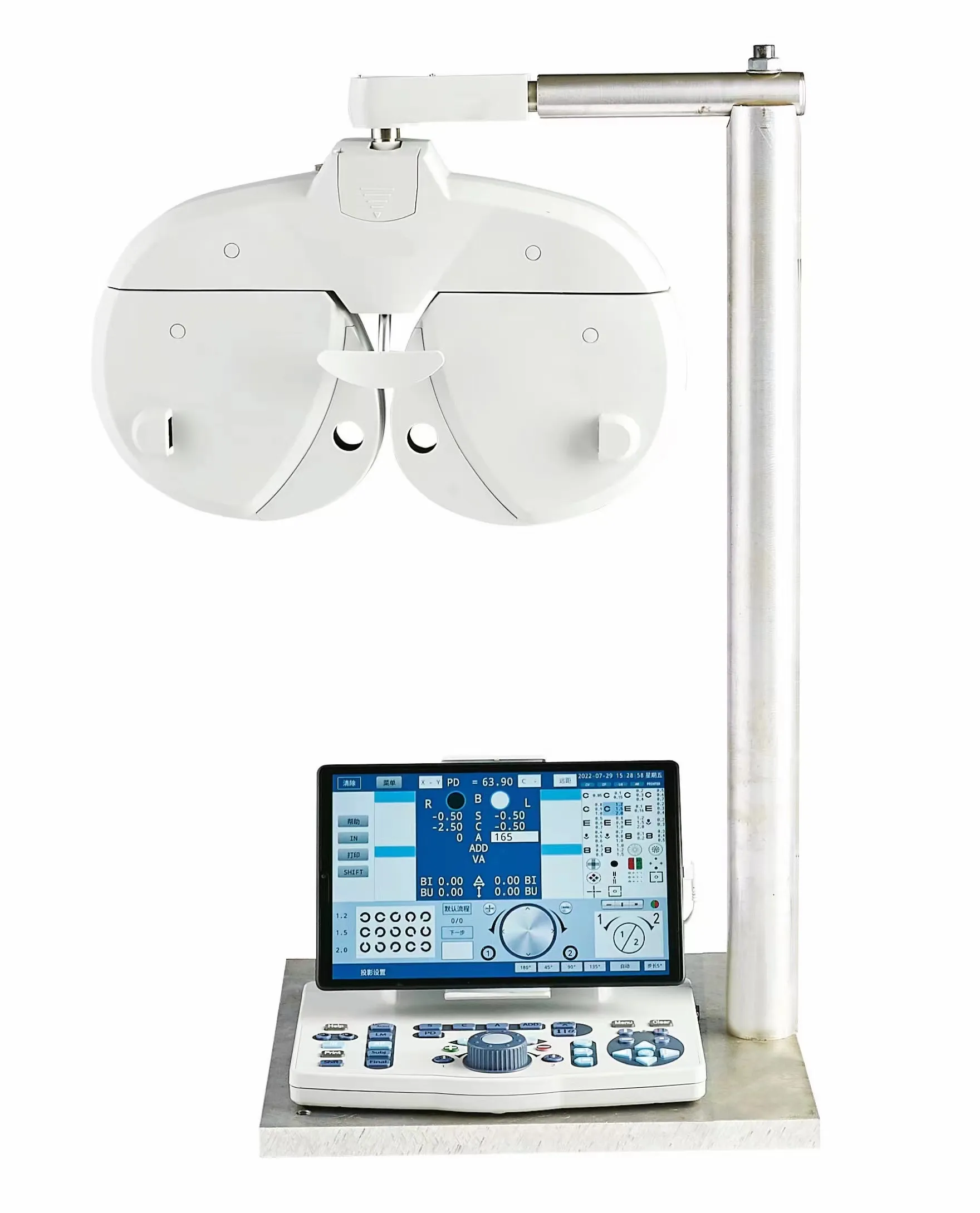
Compare manual and auto phoropter models side by side to see how dial layout, lens range, and accessory compatibility differ across tiers.
4. Key Components and What They Do
Regardless of manual or digital, every phoropter machine has the same five functional components. Knowing what they do helps with servicing, accessory selection, and operator training.
| Component | Function | Typical Specs |
|---|---|---|
| Sphere Drum | Adjusts spherical power (myopia / hyperopia correction) | Range ±19.00 D, ±0.25 D steps (±0.12 D on digital) |
| Cylinder Drum | Adjusts astigmatic power | Range 0 to ±8.00 D, ±0.25 D steps |
| Axis Control | Rotates cylinder axis (1° to 180°) | Manual 5° steps on mechanical units; 1° on digital |
| Jackson Cross-Cylinder | Refines cylinder power and axis via flip comparison | ±0.25 D or ±0.50 D JCC, toggle-flip on digital |
| Auxiliary Lens Bank | Holds pinhole, occluder, Maddox rod, prism, R/G filter | 10-positions typical; digital units may add near-vision chart trigger |
5. Phoropter Price Ranges at a Glance
Like slit lamps, phoropter prices span a wide range based on technology tier, brand, and feature set. The table below reflects typical MSRP across mainstream ophthalmic brands (Reichert, Topcon, Nidek, Zeiss, Haag-Streit, Luxvision) and excludes bundled stands or trial frames.
| Tier | Typical Price Range | Examples & Best For |
|---|---|---|
| Manual (Entry) | $2,000 – $4,500 | VIM-300, Reichert Phoroptor; startup clinics, second lanes, student training |
| Manual (Precision) | $4,500 – $7,000 | Topcon VT-10; tighter tolerances, smoother mechanics, longer service life |
| Digital (Mid-Range) | $8,000 – $14,000 | CV-700, Nidek RT-5100; motorized lens banks, EHR connectivity |
| Digital (Premium) | $15,000 – $30,000+ | Topcon CV-5000, Zeiss; auto cross-cylinder sequencing, multi-language UI, integrated diagnostics |
Explore phoropter options across all tiers — from manual entry-level to digital mid-range.
6. How to Choose the Right Phoropter for Your Practice
Matching the instrument to clinical workflow prevents the two most common procurement mistakes: buying a digital unit for a low-volume practice (overpaying) or sticking with a manual unit in a 25+ patient/day practice (underproductivity).
The decision matrix below maps practice type to recommended tier:
| Practice Type | Daily Patient Volume | Recommended Tier | Rationale |
|---|---|---|---|
| Startup Optometry Clinic | 8–15/day | Manual Entry | Low investment; mechanical durability fits intermittent use |
| Established Multi-Doctor Practice | 15–30/day | Digital Mid-Range | EHR integration + faster cross-cylinder pays back in 12-18 months |
| Hospital Ophthalmology Dept | 30+/day | Digital Premium | Auto-sequencing + sub-specialty modes (low vision, pediatric) |
| Teaching Institution | 20+/day | Manual Precision + Digital | Students learn fundamentals on manual; advanced on digital |
| Mobile / Outreach Clinic | Variable | Manual Entry | No power dependency; rugged for transport; quick setup |
Browse phoropter configurations to find the model that matches your daily workflow, or contact our team for a personalized recommendation.
7. Frequently Asked Questions
What is the difference between a manual and a digital phoropter?
A manual phoropter uses mechanical drums and dials to change lens power; the operator manually rotates the sphere and cylinder drums and toggles the Jackson cross-cylinder. A digital phoropter uses a control panel or touchscreen to drive motorized lens banks, can store patient sessions, and transmits the final Rx to an EHR via RS-232 or HL7.
How long does a phoropter last?
A well-maintained phoropter from a reputable manufacturer lasts 15-20 years in routine clinical use. Manual units often outlast digital units because they have fewer electronic components; digital units typically need a control-board or motor service at 8-12 years.
How often should a phoropter be calibrated?
Industry standard is annual calibration by an authorized service technician, with a quick in-office verification of sphere and cylinder zero points every 6 months. Digital units may require software firmware updates during the annual service visit.
Should I buy a used phoropter?
Refurbished phoropters from authorized distributors can offer 30-50% savings over new, particularly for mechanical manual units where wear is easily inspected. Digital phoropters carry more risk on the used market — verify motor condition, firmware version, and remaining service support before purchasing.
When does a digital phoropter deliver ROI?
For a mid-volume practice seeing 15-25 refractions per day, a digital phoropter typically delivers payback within 18-30 months through faster cross-cylinder testing, reduced operator fatigue, fewer transcription errors via EHR integration, and higher billable procedure throughput per chair.
Looking for the right phoropter for your practice? Our team can help you compare models, evaluate workflow fit, and plan a phased upgrade path from manual to digital. Contact us for a personalized recommendation.