
Ophthalmic Equipment Price List 2026: Complete Cost Guide for Eye Clinics
A new ophthalmic exam chair, a phoropter, an auto refractor, and a slit lamp can land anywhere from twelve thousand to one hundred and twenty thousand US dollars total — and that twenty-fold spread is the rule, not the exception, in 2026. Buyers who request three quotes for the same instrument routinely receive figures that differ by a factor of three. The variance is not random. It reflects six structural factors that this guide breaks down, together with transparent price ranges by equipment category, the real difference between factory-direct and dealer channels, and the hidden costs that determine total ownership over a five-year horizon.
This guide is written for clinic owners, purchasing managers, and distributors equipping practices across the United States, India, Brazil, and Mexico. Prices shown are industry-wide ranges in US dollars for 2026, sourced from public B2B directories, regulatory filings, and factory-direct quotations aggregated across our four core markets.
Six Factors That Determine Ophthalmic Equipment Price
The same physical instrument — a tabletop auto refractor, a manual phoropter, a portable slit lamp — sells at sharply different price points depending on six variables that compound on top of each other.
| Factor | Typical Price Impact |
|---|---|
| Brand and manufacturing origin | Established Western brands carry a 200–400 percent premium over equivalent factory-direct instruments from established manufacturing hubs in Asia |
| Technical specifications | Wider measurement range, finer precision, and higher automation (motorized prism, auto-tracking) raise price 30–80 percent within a category |
| Regulatory certification | FDA 510(k) clearance, CE mark under EU MDR, and ISO 13485 add 10–25 percent to base cost and are mandatory in most regulated markets |
| Order volume | Single-unit retail versus ten-unit clinic rollout typically separates unit price by 15–30 percent |
| Customization (OEM / private label) | Brand, color, interface localization, and firmware customization add 5–15 percent on volume orders |
| Sales channel | Regional distributor and dealer markup adds 30–80 percent over the factory-direct price for the same instrument |
Two of these factors — channel and origin — explain most of the variance a buyer sees. A clinic that buys the same auto refractor through a domestic distributor pays roughly double what a peer who imports factory-direct pays for the identical unit, because the distributor covers local inventory, installation, training, and warranty service inside their margin. Neither path is universally correct; the right choice depends on order size, lead-time tolerance, and whether in-country service is a regulatory or operational requirement.
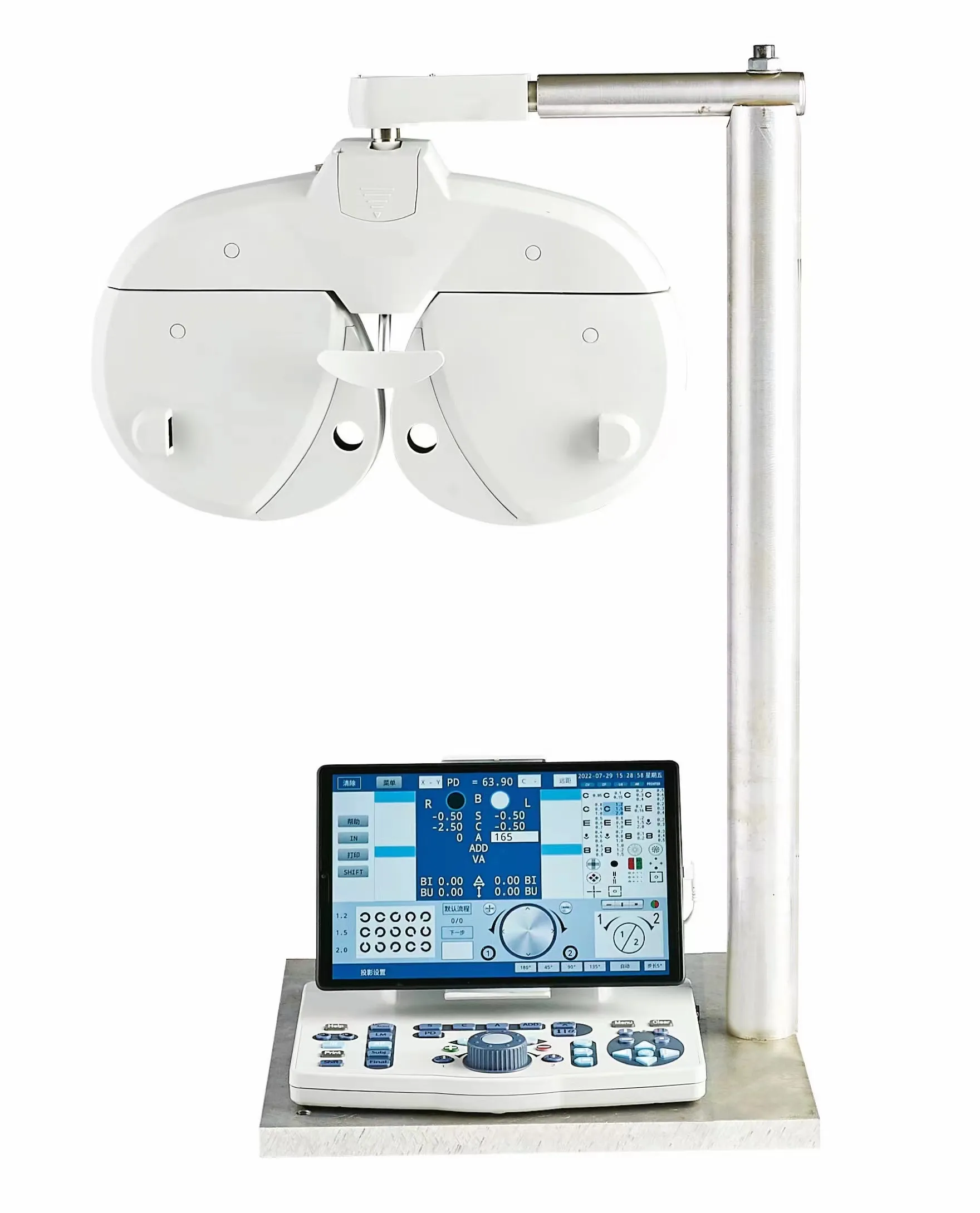
Image: Auto phoropter (AP100 class) — motorized refraction instruments occupy the premium tier of the phoropter price band.
Price Ranges by Equipment Category
The table below consolidates 2026 industry-wide price bands across the eight equipment categories that account for the majority of clinic capital spending. Prices are in US dollars, FOB origin port, and represent typical single-unit transactions. Volume orders of five or more units generally move one tier down in unit price.
| Equipment | Entry | Mid-tier | Premium / Key Driver |
|---|---|---|---|
| Manual [phoropter](/phoropters/) | $800–1,500 | $1,500–2,500 | Build quality, cylinder precision, brand |
| Auto phoropter | $4,000–6,000 | $6,000–9,000 | $9,000–15,000 — chart integration, motorization |
| [Auto refractor](/auto-refractometer/) | $3,500–5,500 | $5,500–8,500 | $8,500–13,000 — keratometry, auto-tracking |
| [Auto lensmeter](/auto-lensmeter/) | $1,500–2,800 | $2,800–4,500 | $4,500–7,000 — UV/blue-light, progressive |
| Tabletop slit lamp | $1,800–3,500 | $3,500–6,000 | $6,000–12,000 — magnification, imaging, illumination |
| [Portable slit lamp](/portable-slit-lamp/) | $1,200–2,500 | $2,500–4,000 | $4,000–6,500 — portability, imaging, battery |
| Chart projector | $600–1,200 | $1,200–2,200 | $2,200–3,500 — chart library, LED, remote |
| [Auto edger](/auto-edger/) | $3,500–6,000 | $6,000–9,000 | $9,000–15,000 — wheel, shape memory, automation |
Read the table horizontally to budget a single exam lane. A entry-tier refraction lane — manual phoropter, entry auto refractor, tabletop slit lamp, basic chart projector — totals roughly eight to fifteen thousand dollars at factory-direct pricing. A premium lane with auto phoropter, high-end auto refractor with keratometry, imaging slit lamp, and auto lensmeter reaches forty-five to seventy-five thousand. Multiplied across a four-lane clinic, the spread between entry and premium configurations is the difference between sixty thousand and three hundred thousand dollars of capital outlay — the same patient throughput, very different financial structure.
For a deeper dive on slit lamp pricing specifically, see the dedicated slit lamp cost guide, which breaks down what drives the gap between a twelve-hundred-dollar portable and a twelve-thousand-dollar imaging-grade tabletop unit.
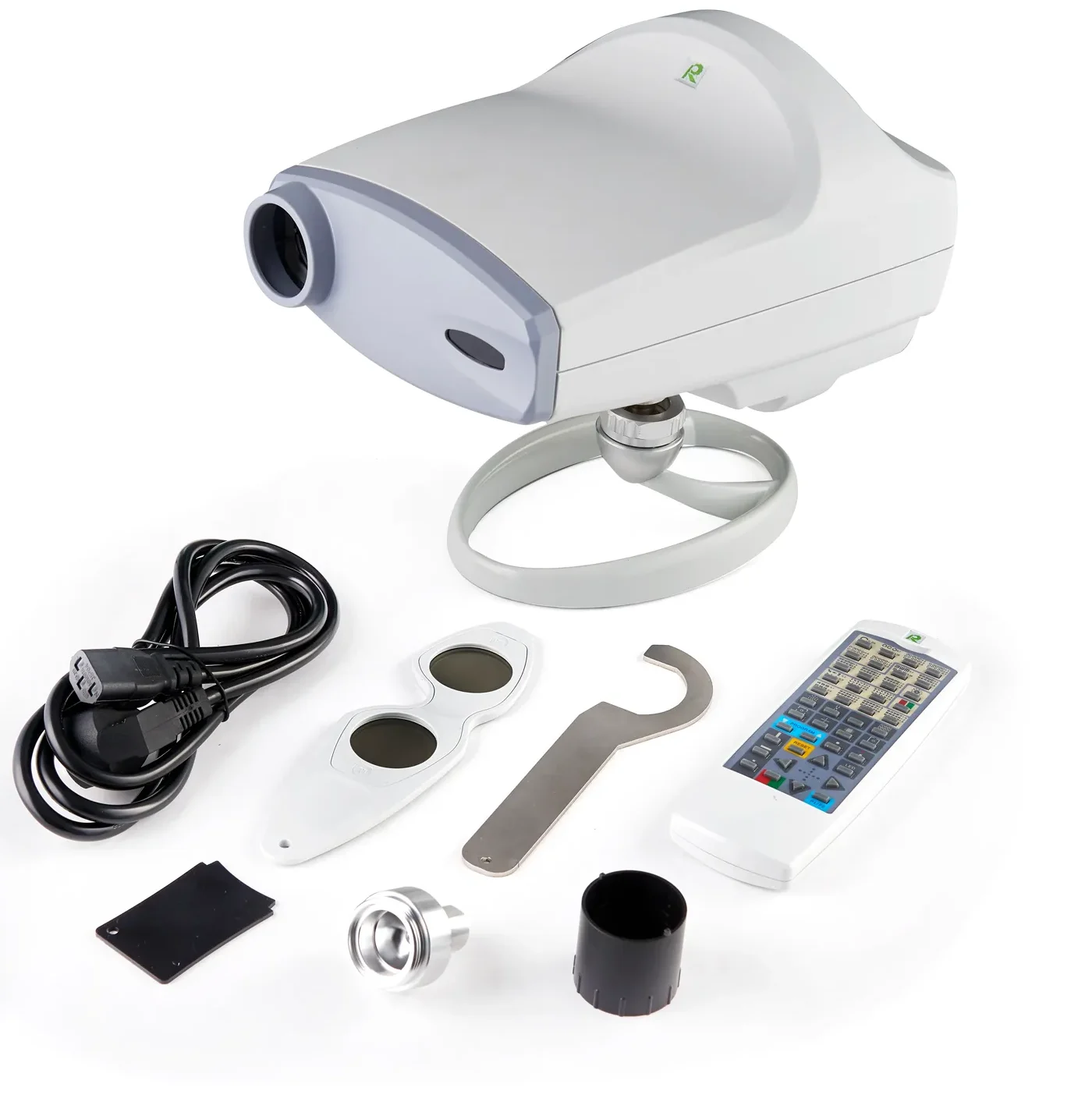
Image: Chart projector (CP-500 class) — chart projectors sit at the lower end of the capital-spend spectrum and are often the simplest category to source factory-direct.
Factory-Direct vs Dealer Pricing — What’s the Real Difference?
The same instrument, sourced through two different channels, can differ in price by thirty to eighty percent. Both channels have legitimate roles; the question is which fits a given buyer.
Dealer pricing bundles local value into the sticker. A domestic ophthalmic equipment dealer typically holds inventory in-country, provides same-week delivery, performs on-site installation and staff training, and handles warranty service through their own technicians. For a single-unit urgent replacement — a slit lamp that failed mid-week in a busy clinic — that bundle is worth the premium. Clinics that lack import experience, customs brokerage relationships, or in-house technical staff should default to dealer pricing.
Factory-direct pricing strips those services out. The buyer takes responsibility for international freight, customs clearance, receiving inspection, and basic installation. In return, unit price drops by thirty to fifty percent on typical orders, and substantially more on multi-unit clinic rollouts. Factory-direct is the dominant channel for distributors reselling under their own brand, for established multi-location chains with central receiving and technical staff, and for hospital systems equipping new satellite clinics on a defined rollout schedule. For these buyers the in-country services that justify dealer markup are either redundant or available as needed from a third-party service partner at lower a la carte cost.
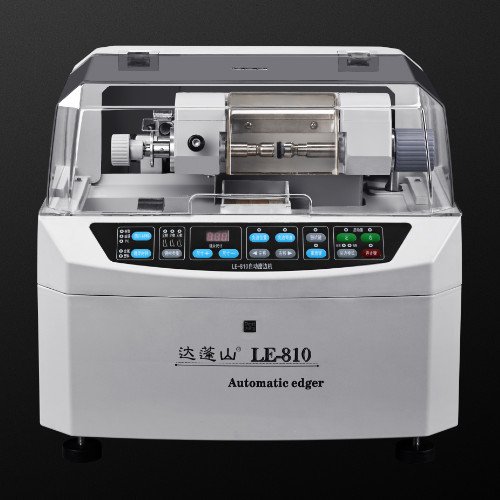
Image: Semi-auto edger (LE-810 class) — lab equipment with high capital cost is where factory-direct sourcing delivers the largest absolute savings.
Hidden Costs Beyond the Sticker Price
The invoice price is one component of total cost of ownership. Buyers comparing factory-direct to dealer channels need to factor in five additional cost layers that the sticker does not show.
| Hidden Cost | Typical Amount | Who Pays |
|---|---|---|
| International freight (sea or air) | $200–1,500 per order | Buyer, under FCA or FOB Incoterms |
| Customs duties and import clearance | 5–15 percent of declared value | Buyer, varies by destination country |
| Installation and training | $0 (remote support) to $2,000 on-site | Channel-dependent |
| Annual calibration and maintenance | 3–8 percent of instrument value per year | Buyer — see the [maintenance guide](/blog/ophthalmic-equipment-maintenance-calibration-guide/) |
| Warranty extension beyond standard term | 5–10 percent of instrument value | Buyer, brand-dependent |
Across a five-year ownership horizon, freight, duties, calibration, and warranty together typically add twenty-five to forty-five percent to the invoice total. The exact figure depends heavily on the destination country’s import regime — clinics in India and Mexico generally see lower effective duty rates on ophthalmic instruments than clinics in Brazil, where complex state-level taxes compound on top of federal import duty. A factory-direct quotation that looks twenty percent cheaper on the invoice can end up only ten percent cheaper after all landed costs are included, or it can end up forty percent cheaper depending on the buyer’s existing logistics relationships.
How to Get an Accurate Quote
An accurate quotation requires six pieces of information from the buyer. Vague inquiries — “send me a price list” — produce vague responses, because responsible suppliers price each configuration against current material costs, certification requirements, and order volume.
The six items are: the specific model or specification range (manual phoropter versus auto phoropter, with or without keratometry); the quantity per model; the destination country and city; the certifications required for that market (FDA, CE, ISO 13485, local health authority registration); any customization (OEM branding, interface language, firmware); and the preferred Incoterm (FCA, FOB, CIF, DDP). With those six items, a factory-direct supplier returns a formal proforma invoice within one business day in most cases.
For clinics unsure which model fits a given lane configuration, the contact page routes to a support queue that helps buyers translate clinical requirements into specific model selections before quotation. Providing patient volume per lane, current equipment being replaced, and the conditions most commonly screened for (refraction, glaucoma, diabetic retinopathy) yields better-targeted recommendations than a generic catalog request.
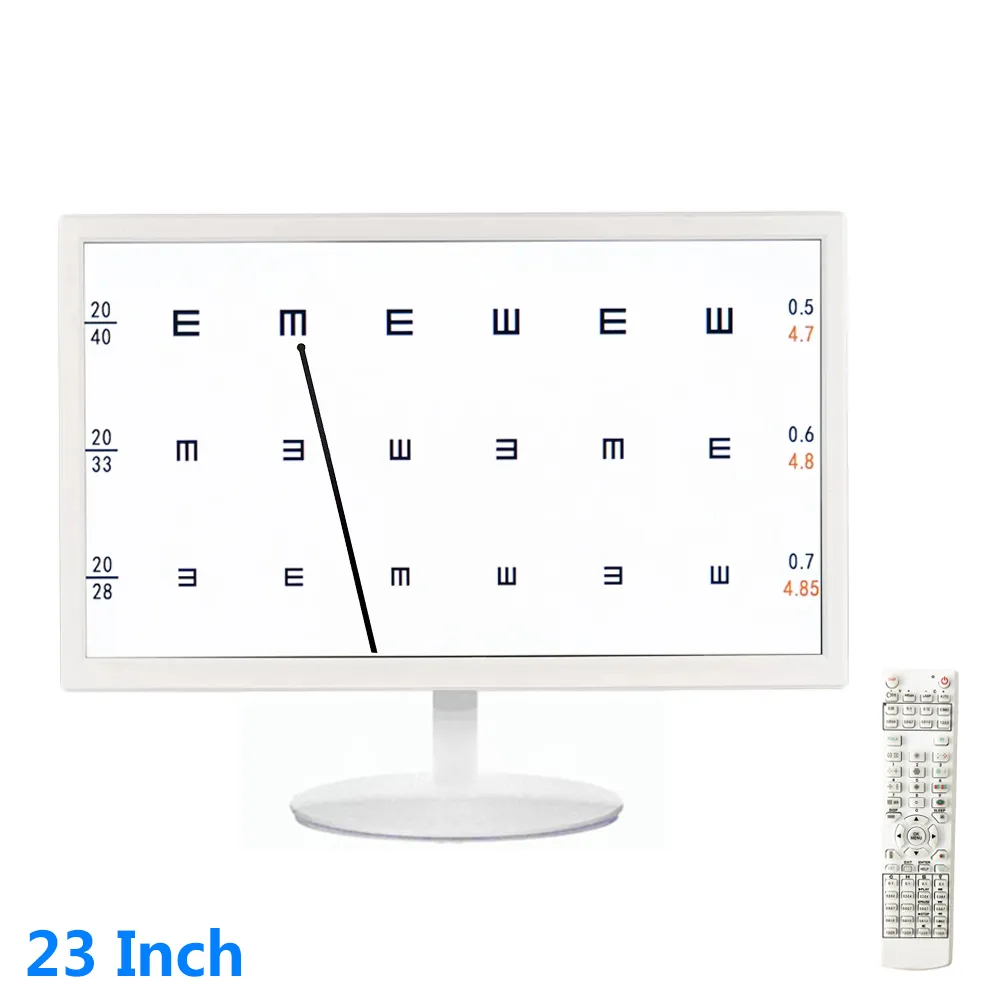
Image: LCD vision chart — chart-category pricing is converging on LCD units as projector demand softens.
Payment Terms for B2B Equipment Buyers
International equipment purchases follow established B2B payment conventions rather than consumer credit card flows. Four payment methods cover the majority of factory-direct transactions.
Wire transfer (T/T) is the most common method, typically structured as a thirty percent deposit on order confirmation with the seventy percent balance due before shipment against shipping documents. This split balances the supplier’s need for production commitment against the buyer’s need to verify the order is built and ready before final payment.
Letter of credit (L/C) is standard for larger orders — generally above thirty thousand US dollars — and for first-time transactions where the buyer and supplier have no payment history. L/C adds bank fees of one to three percent but provides documentary protection for both sides. Established relationships often migrate from L/C to T/T after two or three successful orders.
Incoterms define where responsibility transfers. Under FCA (Free Carrier) and FOB (Free On Board), the buyer takes responsibility for freight and insurance from the origin port or factory — the most common Incoterm for factory-direct clinic orders. Under CIF (Cost, Insurance, Freight) the supplier arranges and pays for freight and insurance to the destination port. Under DDP (Delivered Duty Paid) the supplier handles the entire door-to-door chain including customs; this is rare for factory-direct transactions because it requires the supplier to register for tax in the destination country.
Currency is US dollars for the majority of cross-border ophthalmic equipment trade regardless of origin or destination; Brazilian buyers may quote in US dollars and settle the local real conversion through their own bank. Exchange-rate movements between quotation and payment can shift the effective price by two to five percent, so locking the exchange rate at order confirmation is standard practice.
Frequently Asked Questions
Why do ophthalmic equipment prices vary so widely between suppliers?
Three factors drive most of the variance: manufacturing origin (established Western brands carry a 200–400 percent premium over factory-direct equivalents from established Asian manufacturing hubs), sales channel (dealer markup adds 30–80 percent over factory-direct pricing), and certification scope (FDA, CE, and ISO 13485 documentation adds 10–25 percent). Two quotes for what looks like the same instrument can legitimately differ by a factor of three when all three factors are stacked.
What’s included in BVT’s factory-direct pricing?
Factory-direct pricing includes the instrument, factory calibration certificate traceable to the applicable ISO standard, standard accessories, packaging, and FCA or FOB delivery to the origin port. It excludes international freight, destination customs duties, destination-country taxes, on-site installation, and extended warranty. A formal proforma invoice itemizes what is and is not included for the specific configuration quoted.
Can I get a discount for bulk clinic orders?
Yes. Multi-unit orders typically move one price tier down on unit cost — roughly a 15–30 percent reduction on the single-unit price for orders of five to ten units, with deeper discounts for full clinic chain rollouts. OEM customization (private-label branding, interface localization) becomes economically attractive on orders above twenty units and is quoted separately from the hardware.
What payment methods does BVT accept for international orders?
Wire transfer (T/T) with a 30 percent deposit and 70 percent balance before shipment is the standard method. Letters of credit (L/C) are accepted for orders above thirty thousand US dollars and for first-time transactions. Credit card payment is not available for B2B equipment orders; the merchant fees and chargeback risk on five-figure transactions are incompatible with factory-direct pricing.
Are there recurring costs beyond the initial purchase?
Yes. Annual calibration and maintenance typically runs 3–8 percent of instrument value per year, and warranty extension past the standard term adds 5–10 percent. Across a five-year ownership horizon, these recurring costs add 25–45 percent to the initial invoice total. The maintenance and calibration guide covers how to budget and schedule these costs.
Conclusion
Transparent pricing turns equipment purchasing from a negotiation into a decision. Once the six structural factors — origin, channel, certification, volume, customization, and specifications — are separated from each other, the apparent chaos of three competing quotes collapses into a clear comparison. The 2026 price ranges in this guide give buyers across the US, India, Brazil, and Mexico a defensible reference point against which any quotation can be evaluated.
For a formal proforma invoice on a specific configuration, list the six items above — model, quantity, destination, certifications, customization, Incoterm — and submit through the contact page. First-line quotations are typically returned within one business day, with calibration certificates and lead times confirmed in the same response.